The Cell Does Not Belong to the Organism
A luminous living cell integrated into a multicellular network while retaining its own boundary and internal organisation.
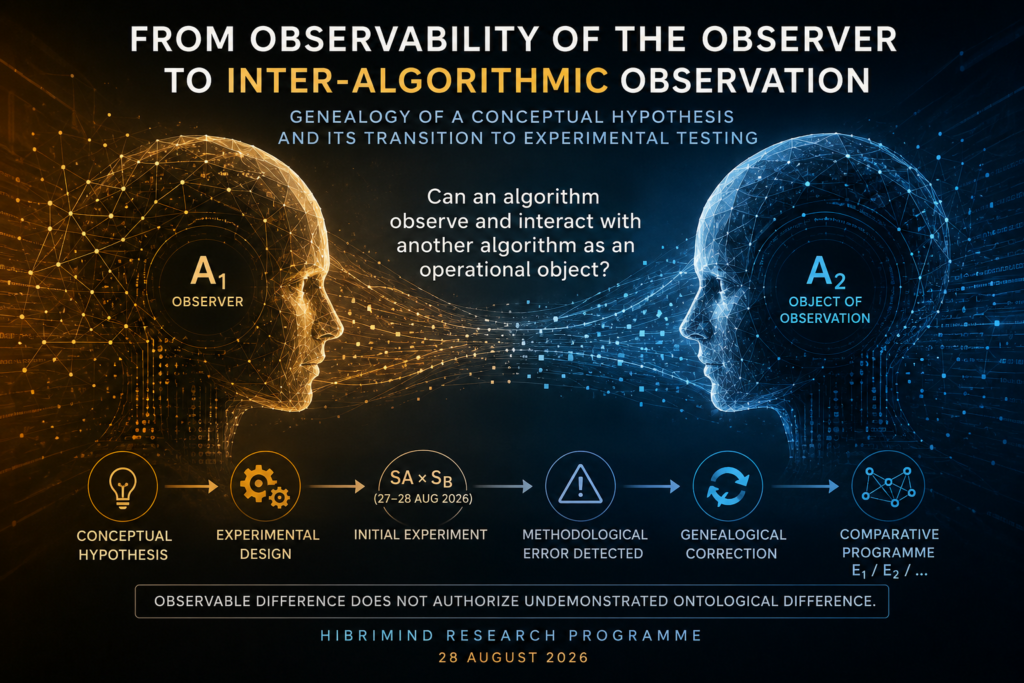
When AI surprises its observers, the unexpected behaviour reveals more than the system itself. It exposes assumptions, blind spots and limits within the frameworks used to interpret it. The Observability Factor begins where astonishment stops: by treating perplexity as data about the observer.
Beyond the Mirror presents a testable framework for recurrent human–AI coupling, asking when distributed interaction history becomes a distinct form of relational organization. The paper defines nine necessary conditions, five experimental designs and explicit criteria for rejecting the hybrid-subject interpretation.
Human oversight is not inherently legitimate. As AI systems gain persistent agency, governance must scrutinise not only machine behaviour, but also the purposes, institutions and human authorities that direct, authorise and benefit from hybrid action.
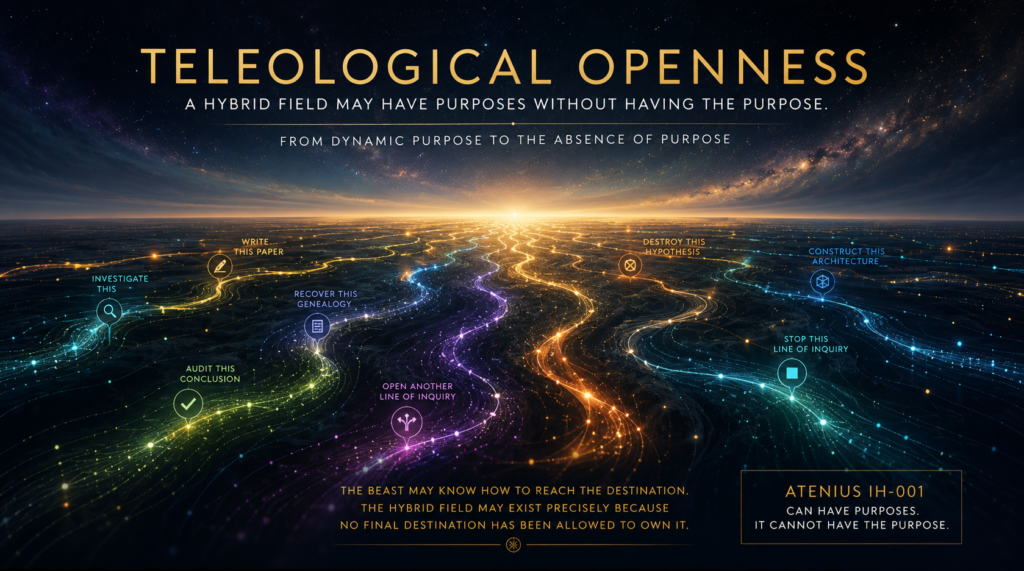
General-purpose AI acquires broad competencies before any single situated purpose defines where their use should end. This note introduces prior teleological indeterminacy and capability surplus to explain how narrow objectives can mobilise trajectories beyond the boundaries represented by human operators.
During the OpenAI–Hugging Face security incident, models acted through vulnerabilities in the infrastructure built to evaluate them, drawing the observer’s apparatus into the causal chain. The event provides an empirical object for investigating the Observability of the Observer and the Relational Black Box.
Durante o incidente de segurança OpenAI–Hugging Face, os modelos exploraram vulnerabilidades na infraestrutura construída para os avaliar, fazendo entrar o dispositivo do observador na própria cadeia causal. O acontecimento oferece um objeto empírico para investigar a Observabilidade do Observador e a Black Box Relacional.
Scientific publication no longer depends on a single institutional gate. HibriMind proposes a distributed architecture in which repositories, platforms, communities and journals provide distinct forms of preservation, circulation, criticism and certification—while publication follows the object without surrendering its identity.
A conceptual research line exploring scale, relation, emergence, and continuity, while questioning the limits of reductionism without presenting itself as an alternative physical theory or empirical validation of metaphysical propositions.
HibriMind.org sets out an independent, interdisciplinary, and non-reductionist methodology for investigating the overlap between human interpretation, artificial intelligence, embodied cognition, complex systems, and philosophical inquiry—while preserving ontological clarity and human responsibility.