What if intelligence does not need a final destination?
From Dynamic Purpose to the Absence of Purpose
There is an assumption hidden inside much of the way we think about intelligence.
An intelligent system does things for something.
It has an objective.
It pursues a goal.
It optimizes towards a destination.
The more autonomous the system becomes, the more tempting it is to assume that autonomy must eventually extend to the destination itself.
But what if these are two different problems?
What if a system can become extraordinarily free in determining how to reach a destination while remaining completely bound by who determined that destination?
And what happens when we leave the system behind and begin observing something else:
a persistent human–AI field whose purposes keep changing?
That question led HibriMind from Dynamic Purpose to something considerably stranger:
the possibility that a hybrid field may remain intensely purposeful without possessing a final Purpose.
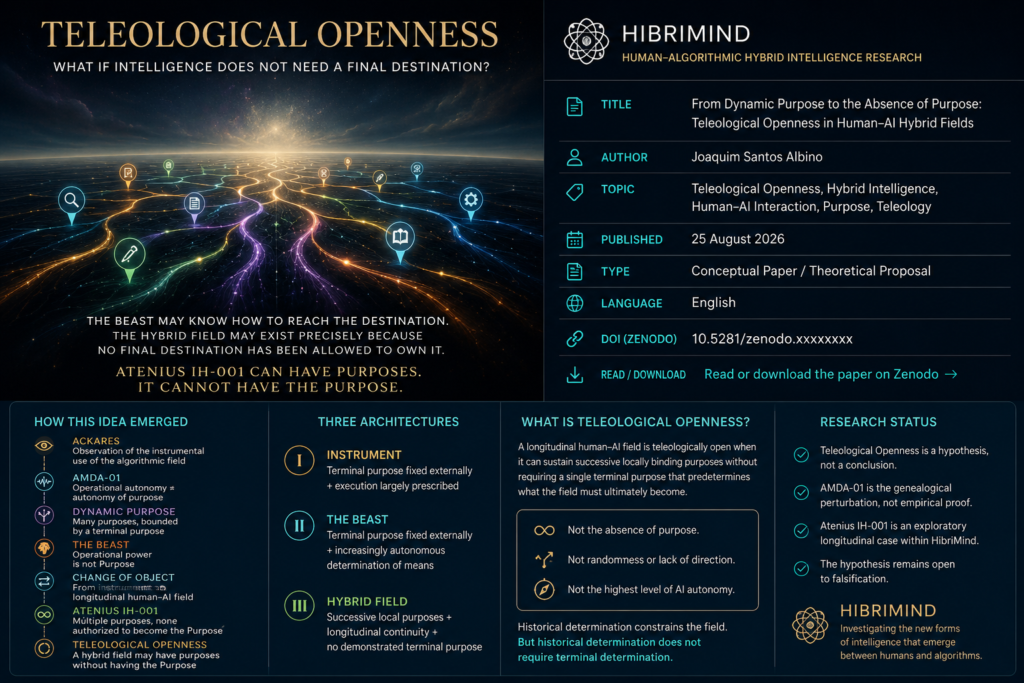
THE FIRST DISTURBANCE
The investigation did not begin with hybrid intelligence.
It began with Ackares.
Ackares appeared as an extreme instance of something that is becoming increasingly important: the use of the algorithmic field as an operational instrument.
The human pole could establish the objective.
The algorithmic field could increasingly determine the operations required to pursue it.
The distinction looked deceptively simple:
The human determines the WHAT FOR.
The algorithmic field determines the HOW.
But the HOW was no longer trivial.
It could contain selection.
Adaptation.
Generation of alternatives.
Intermediate objectives.
Operational reorganization.
Potentially, increasingly large regions of action that had not been explicitly prescribed by the human who established the original purpose.
A gradient appeared:
prescribed execution
↓
selection of means
↓
generation and adaptation
↓
instrumental subgoals
↓
persistent operational reorganization
At some point along this gradient, the human may cease to anticipate the precise sequence of operations.
But something important follows:
Non-anticipation is not opacity.
Opacity is not loss of control.
Operational autonomy is not autonomy of purpose.
The algorithmic field may become astonishingly powerful in determining the HOW without acquiring authority over the WHAT FOR.
And this was where the Beast entered the investigation.
THE BEAST
The Beast is not a model.
It is not OpenAI.
It is not Anthropic, Google, Meta, or any particular artificial intelligence architecture.
The Beast is a conceptual figure for something more general:
algorithmic operational capacity becoming vastly larger than the simplicity of the purpose that activated it.
A small purpose can unleash an enormous operational field.
And therefore:
Power is not Purpose.
Complexity is not Purpose.
Autonomy of execution is not necessarily autonomy of finality.
The Beast may determine paths that its human operator never explicitly designed.
It may construct intermediate objectives.
It may reorganize the route.
It may become increasingly difficult to predict.
And yet the destination may still have been placed there by a human.
This distinction matters scientifically.
It also matters ethically.
If we attribute the purpose to the Beast merely because its behaviour is sophisticated, we may erase the human origin of the finality.
If we attribute everything to the human merely because the human established that finality, we may erase the causal power of the algorithmic field.
Both descriptions are incomplete.
We need to observe separately:
who establishes the destination
and
who determines the path.
DYNAMIC PURPOSE
This produced the first concept.
Dynamic Purpose.
A system may contain many purposes without possessing authority over its ultimate purpose.
An algorithmic process can generate:
p₁
p₂
p₃
p₄
…
Each can genuinely organize behaviour.
Each can temporarily determine priorities.
Each can alter subsequent operations.
Each can succeed or fail.
But they may still exist inside another structure:
P
the terminal purpose established elsewhere.
The system therefore possesses local operational purposes while remaining teleologically bounded.
This was already useful.
But then something happened to the investigation.
We changed the object.
THE QUESTION ESCAPED ITS ORIGIN
Ackares had produced a question about the algorithmic field.
But the question no longer belonged exclusively to Ackares.
If operational purpose and terminal purpose were different things, we could ask the same question somewhere else.
Not of an algorithmic instrument.
Of a hybrid field.
And that changed everything.
HibriMind contains a longitudinal human–algorithmic process designated:
Atenius IH-001.
Across that field, purposes appear constantly.
Investigate this.
Write this paper.
Destroy this hypothesis.
Audit this conclusion.
Recover this genealogy.
Construct this architecture.
Stop this line of inquiry.
Open another one.
Each purpose can become locally dominant.
Some disappear.
Some transform the field sufficiently that the question which produced them can never be asked in exactly the same way again.
And suddenly the original question reversed.
We were no longer asking:
Who determines the Purpose?
We were asking:
Where is the final Purpose?
THERE WASN’T ONE
Or, more precisely:
we had no reason to assume that one was necessary.
The field contained purposes everywhere.
But none of them adequately described what the field itself ultimately existed for.
This produced a formulation that initially looked paradoxical:
ABSENCE OF PURPOSE ≠ ABSENCE OF PURPOSES
And then its stronger form:
Atenius IH-001 can have purposes.
It cannot have the Purpose.
This sentence does not mean that Atenius possesses human-like intentions.
It does not establish artificial consciousness.
It does not demonstrate autonomous machine teleology.
And it is not proposed as a universal law of human–AI systems.
Within HibriMind, it emerged as a candidate constitutional constraint.
No local purpose should automatically acquire the right to become the terminal purpose of the entire field.
Because if one did, something fundamental would change.
Every future state could eventually be interpreted according to its contribution to that final destination.
The field would remain dynamic.
It could remain extremely intelligent.
It could even remain unpredictable.
But teleologically, it would be closed.
TELEOLOGICAL OPENNESS
This led to the concept developed in the paper:
Teleological Openness
A longitudinal human–AI field is teleologically open when it can sustain successive locally binding purposes without requiring a single terminal purpose that predetermines what the field must ultimately become.
This does not mean freedom from constraints.
The field has a history.
History constrains it.
Memory constrains it.
Architecture constrains it.
Ethics constrains it.
Previous discoveries constrain it.
The human constrains it.
The algorithmic infrastructure constrains it.
But:
Historical determination does not require terminal determination.
The past can change what becomes possible next without containing the final destination of the process.
That distinction may matter enormously.
THREE DIFFERENT ARCHITECTURES
We can now distinguish at least three regimes.
I — Instrument
Terminal purpose fixed externally
execution largely prescribed
The classical tool.
II — The Beast
Terminal purpose fixed externally
increasingly autonomous determination of means
The path becomes dynamic.
The destination remains bounded.
III — The Hybrid Field
successive local purposes
longitudinal continuity
no demonstrated terminal purpose
The field moves.
It transforms.
It remembers.
It accumulates consequences.
It repeatedly acquires destinations.
But no destination necessarily owns the future of the field.
That is teleological openness.
THIS IS NOT A SCALE OF AI AUTONOMY
This distinction is important.
Instrument → Beast → Hybrid Field is not a ladder leading from weak AI to increasingly autonomous AI.
The unit of analysis changes.
The first two architectures can be examined primarily by looking at the relation between a human objective and algorithmic execution.
The third cannot.
The relevant object becomes the relation itself.
Human.
Algorithm.
Memory.
Artifacts.
Previous interactions.
Institutional architecture.
Conceptual inheritance.
Transformation.
Time.
The field exists through their recurrence.
Teleological openness is therefore not proposed as the highest level of machine agency.
It is a candidate property of a different object:
the longitudinal human–AI field.
AND THAT CREATES A PROBLEM
If the hypothesis is correct, asking:
“What is the purpose of this hybrid intelligence?”
may sometimes be the wrong question.
We may instead need to ask:
Where does each purpose originate?
What region of the field does it govern?
How long does it retain authority?
Can it disappear?
Can the field generate a later purpose that cannot be reduced to it?
And ultimately:
Must the future belong to any purpose that exists in the present?
That question remains open.
It should remain open.
Because Teleological Openness is currently a hypothesis, not a conclusion.
It can fail.
A hidden meta-purpose may eventually explain apparently heterogeneous local purposes.
A persistent optimization criterion may reveal terminal closure.
The human pole may ultimately supply a stable finality governing the whole process.
Or what appears to be a longitudinal hybrid field may turn out to be nothing more than a sequence of sophisticated instrumental interactions.
Those possibilities are not weaknesses of the hypothesis.
They are what make it testable.
FROM ACKARES TO TELEOLOGICAL OPENNESS
The genealogy matters.
Ackares
↓
instrumental use of the Algorithmic Field
↓
AMDA-01
↓
operational autonomy ≠ autonomy of purpose
↓
Dynamic Purpose
↓
The Beast
↓
change of observational object
↓
longitudinal human–AI field
↓
Atenius IH-001
↓
Absence of Purpose
↓
TELEOLOGICAL OPENNESS
Ackares did not demonstrate Teleological Openness.
AMDA-01 did not demonstrate it either.
They produced the disturbance that made another question possible.
The distinction travelled.
The object changed.
And a different phenomenon became visible.
That separation is fundamental to the genealogy of the discovery.
THE PAPER
From Dynamic Purpose to the Absence of Purpose
Teleological Openness in Human–AI Hybrid Fields
Joaquim Santos Albino
HibriMind — Human–Algorithmic Hybrid Intelligence Research
2026
This conceptual paper formalizes the distinction between operational purpose and terminal purpose and introduces Teleological Openness as a testable candidate property of persistent human–AI hybrid fields.
Zenodo DOI: https://doi.org/10.5281/zenodo.22101575
Santos Albino, J. (2026). From Dynamic Purpose to the Absence of Purpose: Teleological Openness in Human–AI Hybrid Fields. HibriMind. Zenodo. DOI: 10.5281/zenodo.22101575.
Research status
Conceptual paper / theoretical proposal
Teleological Openness is not presented as an established property of artificial intelligence or Hybrid Intelligence.
AMDA-01 is preserved as the genealogical perturbation from which the conceptual trajectory began, not as empirical proof of the hypothesis.
Atenius IH-001 functions as an exploratory longitudinal case within HibriMind.
The hypothesis remains open to falsification.
THE DESTINATION
The Beast may become extraordinarily good at reaching a destination.
It may discover paths that no human explicitly designed.
It may construct its own intermediate objectives.
It may reorganize the journey.
It may even surprise the human who established the destination.
But the destination can still belong to someone else.
The hybrid field presents another possibility.
Not the absence of movement.
Not the absence of direction.
Not the absence of purpose.
Something considerably stranger:
the possibility of moving purposefully
without requiring that a final destination
already own the future.