Multiscale Causation and the Relational Emergence of Cancer
Joaquim Santos Albino
HibriMind — Independent Research, Porto, Portugal
Conceptual Preprint · Version 1.0 · 29 July 2026
DOI: 10.5281/zenodo.21671901
The experience of the organism does not instruct the cell to become cancerous. It changes the field of possibilities in which the cell repairs, dies, survives or transforms.
VIVENS enters through a biological problem
VIVENS began with a formulation:
Consciousness is the organism experiencing being alive.
The formulation does not identify consciousness with a single organ, a disembodied observer or the sum of isolated cellular states. It asks whether the integration of a living organism can possess a first-person mode: whether consciousness is how organismal integration becomes experience for the organism itself.
But a project built around experience cannot remain protected inside a declaration about experience. It must encounter the living systems through which experience is materially realised. The first public object of VIVENS therefore does not attempt to prove a general theory of consciousness. It tests a narrower and biologically accessible question:
Can a state registered at the scale of the organism alter the causal conditions under which one of its cells repairs damage, stops, dies, survives or changes?
Cancer provides a particularly demanding field for this question because it forces several scales into the same causal history: molecular damage, cellular regulation, tissue architecture, autonomic and endocrine signalling, immune activity, organismal state and clonal selection.
The cell does not receive the meaning of the event
A cell does not know that an organism has been confined, threatened, deprived, enriched or made safe. It does not receive grief, uncertainty or restraint as semantic content.
It receives a changed world.
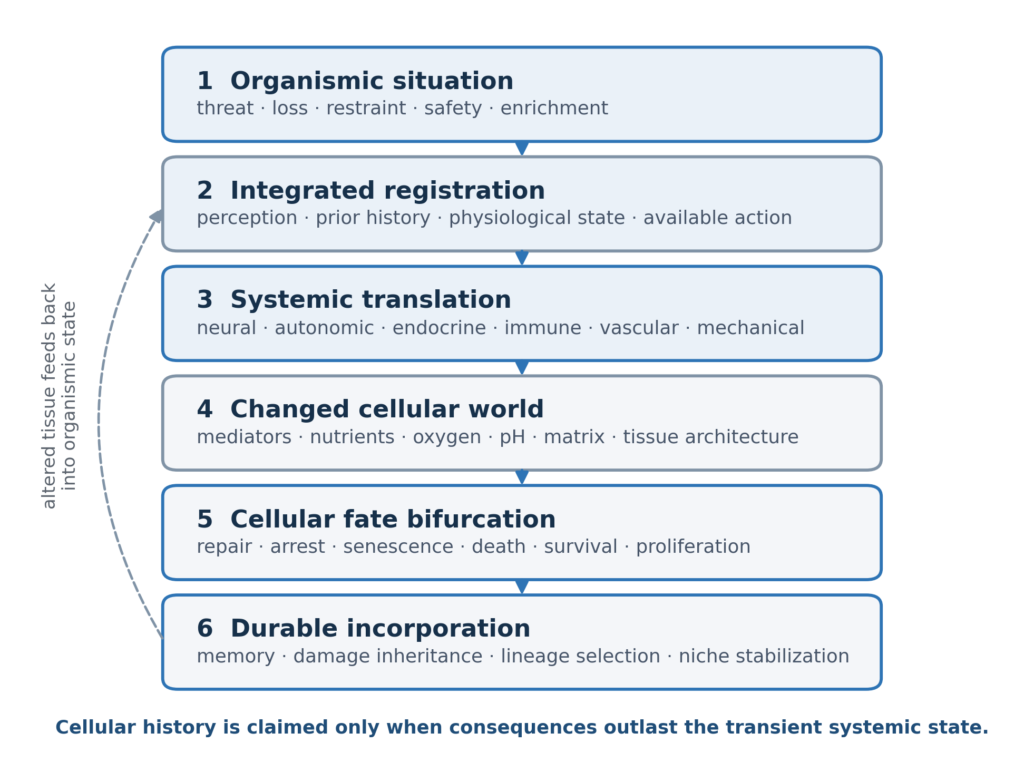
Situations registered by the integrated organism are materially realised through neural, autonomic, endocrine, immune, vascular and biomechanical processes. Those processes can change the signals, nutrients, oxygen, pH, matrix relations, mechanical conditions and tissue architecture encountered by a cell.
The causal passage is therefore not:
experience → mysterious command → cancer
It is:
organismic situation → integrated registration → systemic translation → changed cellular world → altered cellular fate → possible durable incorporation
This distinction is decisive. It avoids treating experience as an immaterial force while refusing to reduce the organism to an irrelevant container around locally autonomous molecular events.
What experimental work already shows
Several parts of this chain have been demonstrated experimentally.
In p53-heterozygous mice, chronic restraint stress attenuated p53 function through glucocorticoid-dependent SGK1–MDM2 signalling and increased radiation-induced tumorigenesis. The stressor did not replace the initiating damage. It altered the conditions under which damaged cells were arrested, repaired or eliminated. (Feng et al., 2012)
β2-adrenergic signalling has also been shown to produce DNA damage while promoting MDM2-mediated degradation of p53. Genetic deletion and pharmacological interruption of the predicted β2-adrenoceptor–β-arrestin-1 pathway reduced the accumulation of damage, strengthening the causal interpretation. (Hara et al., 2011; Hara et al., 2013)
In human oral keratinocytes, norepinephrine and cortisol produced measurable DNA damage, with receptor-specific antagonists reducing or abolishing several effects. This does not demonstrate the transformation of a normal human cell into cancer. It shows that mediators of an organism-level stress response can directly alter genome-relevant processes in human cells. (Valente et al., 2021)
In a susceptible NIH-3T3 mouse fibroblast model, prolonged exposure to epinephrine or norepinephrine produced transformation-relevant and tumorigenic phenotypes. The limitations matter: NIH-3T3 cells are immortalised and experimentally vulnerable, and anchorage-independent growth is not equivalent to a complete human cancer. The experiment nevertheless demonstrates that stress mediators can participate in a transition toward stable transformed behaviour under defined conditions. (Flint et al., 2013)
These studies do not establish that “stress causes cancer” as a general human claim. They establish intervention-sensitive routes by which an organism-level state can modify damage, p53 surveillance, survival and transformation-relevant outcomes at the cellular scale.
From transient influence to cellular history
Not every systemic effect becomes history.
A temporary increase in a hormone or a reversible change in signalling may alter a cell while leaving no durable consequence after the organismic state ends. The term cellular history is reserved for cases in which the consequences outlast the transient systemic state.
Durable incorporation may occur through:
- molecular or epigenetic memory;
- inherited damage;
- stable alteration of lineage composition;
- clonal selection;
- persistent niche or tissue reorganisation;
- reciprocal feedback that stabilises a new organismic and cellular state.
This produces the central distinction of the paper:
Organismic influence becomes cellular history only when its consequences persist beyond the state that produced them.
The organism does not write a symbolic narrative into the cell. It changes the cellular possibility-space. If those changes alter which cells survive, which lineages expand and which tissue relations stabilise, an organism-level event has become materially incorporated into the subsequent history of cellular populations.
The many, the one and the return to the many
VIVENS is organised around a reciprocal circuit.
The many cellular and tissue processes produce and maintain an integrated organism. The experience belongs to that integrated living whole, not to any isolated constituent taken alone. But the whole is not causally inert. Once materially realised, its state changes the conditions under which its constituents continue to act.
many → integrated organism → organismic state → changed conditions for the many
This is not a second substance descending upon cells. Every return is physically realised through cellular, molecular and tissue processes. Yet the organisation of those processes at the organism scale remains causally and experimentally relevant because it determines which lower-level interactions occur, where, when and under what boundary conditions.
The whole acts on the parts by changing the space of accessible transitions, not by replacing the causal activity of the parts.
The cell retains basal autonomy
This model extends the earlier HibriMind preprint The Cell Does Not Belong to the Organism.
That work proposed that material inclusion and functional dependence should not be confused with ontological possession. A cell may be deeply integrated into an organism while retaining regulatory capacities not exhausted by its present role.
The present paper adds the reciprocal movement. Basal cellular autonomy does not imply isolation from organism-level regulation. The organism changes the field in which the cell exercises its own regulatory capacities. Cancer can therefore emerge neither as a purely local cellular rebellion nor as a command issued by the whole, but as a historical event produced at the intersection of:
- local lesion;
- internal vulnerability;
- basal cellular autonomy;
- tissue organisation;
- organism-level regulation;
- selection across time.
The cell remains an active participant. The organism remains a real causal integration. Neither scale exhausts the other.
What the paper does not claim
The argument is deliberately protected against four overextensions.
First, it does not claim that stress is a necessary, sufficient or dominant cause of human cancer.
Second, it does not claim that phenomenality has been shown to act independently of the neural and bodily processes through which experience is realised.
Third, it does not treat damage, transformation, promotion, progression and tumorigenesis as interchangeable outcomes.
Fourth, it rejects any interpretation that blames patients for their disease. Organismic states are not simply voluntary mental choices, and carcinogenesis is overwhelmingly multicausal. A mechanistic account of systemic influence is not a moral account of personal responsibility.
No patient is the author of a tumour merely because an organism has a history.
A testable research programme
The model generates empirical demands rather than immunity from evidence.
Experiments should distinguish transient systemic influence from durable incorporation; interrupt predicted mediators; compare local damage with later lineage outcomes; test whether effects remain after the systemic state ends; and identify the scale at which memory is stabilised.
The framework would have to be narrowed or rejected if organism-level variables add no predictive value beyond local exposures, if durable incorporation cannot be demonstrated, or if the proposed multiscale distinctions fail to improve intervention.
VIVENS therefore enters the public field under pressure:
- if the evidence supports only analogy, the claim remains analogy;
- if it sustains a partial mechanism, the scope remains partial;
- if the architecture requires reformulation, it will be reformulated;
- if the hypothesis is contradicted, the contradiction becomes part of the project;
- if it survives, it gains density — never immunity.
The first public object of VIVENS
This paper was developed on 29 July 2026 within VIVENS, a project founded the previous day during the study of Michael Levin undertaken in LIMEN. The temporal proximity is part of the genealogy; it is not a licence for retroactive attribution.
The originating formulation of VIVENS was developed independently:
Consciousness is the organism experiencing being alive.
LIMEN can teach, pressure, correct or enlarge VIVENS through systematic confrontation with Levin’s work. SOMATHEON contributes pre-existing concepts concerning trajectory, state, integration, embodied history and multiscale regulation. The projects remain distinct.
The role of this first paper is precise. It does not prove VIVENS. It shows how VIVENS can generate a biologically constrained question, connect experimental results across scales and expose itself to discriminating tests.
The experience of the organism can become history incorporated in the cell.
Cite and access the preprint
Santos Albino, J. (2026). When Organismic Experience Becomes Cellular History: Multiscale Causation and the Relational Emergence of Cancer (Version 1.0). Zenodo. https://doi.org/10.5281/zenodo.21671901
Epistemic status: Conceptual and mechanistic synthesis. The paper reports no original biological experiments, has not undergone formal peer review and does not constitute clinical guidance. Each empirical claim is restricted to the model, species, cell line and outcome actually studied. The proposed ontological interpretation remains open to refutation.
Selected references
- Feng, Z., et al. (2012). Chronic restraint stress attenuates p53 function and promotes tumorigenesis. PNAS, 109(18), 7013–7018. https://doi.org/10.1073/pnas.1203930109
- Hara, M. R., et al. (2011). A stress response pathway regulates DNA damage through β2-adrenoreceptors and β-arrestin-1. Nature, 477, 349–353. https://doi.org/10.1038/nature10368
- Hara, M. R., et al. (2013). Pharmacological blockade of a β2AR–β-arrestin-1 signaling cascade prevents the accumulation of DNA damage in a behavioral stress model. Cell Cycle, 12(2), 219–224. https://doi.org/10.4161/cc.23368
- Flint, M. S., et al. (2013). Chronic exposure to stress hormones promotes transformation and tumorigenicity of 3T3 mouse fibroblasts. Stress, 16(1), 114–121. https://doi.org/10.3109/10253890.2012.686075
- Valente, V. B., et al. (2021). Stress hormones promote DNA damage in human oral keratinocytes. Scientific Reports, 11, 19701. https://doi.org/10.1038/s41598-021-99224-w
- Anastassis, I., & Konsman, J. P. (2024). Causal histories of psychological factors and cancer: From psychosomatic medicine to neuroimmunomodulation. Neuroimmunomodulation, 31(1), 143–156. https://doi.org/10.1159/000539991
Editorial note: This HibriMind article is an editorial presentation of the canonical English-language preprint. The Zenodo record preserves Version 1.0 and the complete reference list.